The Role of AI in IT Operations
IT Operations, also known as ITOps, has always had a deceptively simple mission: keep the technology businesses depend on running.
Today, that job is anything but simple.
Applications span numerous systems that are deeply interconnected, and an issue in one layer can quickly become a problem somewhere else. At the same time, IT teams are responsible for more than keeping servers online. They are expected to maintain application performance, optimize infrastructure, support users, manage incidents, protect systems, maintain availability, and help the business adopt new technology — all while controlling costs.
IT environments produce enormous amounts of data. The challenge for modern IT operations isn’t simply collecting that information — it’s turning it into something useful.
This is where Artificial Intelligence (AI) is starting to play a bigger role in IT Operations. AI and automation are transforming the way organizations manage their IT infrastructure, enabling more efficient, reliable, and scalable operations.
Our recent blogs explored what AI actually is and how to prepare a solid AI foundation. This blog delves into the pivotal role AI and automation play in ITOps, exploring their benefits, challenges, and the future landscape.
What Is ITOps?
IT operations (ITOps) encompasses the people, processes, and technologies responsible for implementing, managing, delivering, and supporting IT services for an organization and its users.
ITOps may be responsible for:
- Managing hardware, software, networks, and infrastructure
- Provisioning resources for applications and development teams
- Managing private, public, and hybrid cloud environments
- Optimizing infrastructure performance and resource utilization
- Supporting application performance
- Managing incidents and troubleshooting problems
- Supporting service desks and ticketing processes
- Managing backups and supporting disaster recovery
- Monitoring availability and performance
- Addressing security and compliance requirements
IT exists to support your business, and ITOps is responsible for helping ensure that the technology behind your services remains available, performant, secure, and reliable.
Why Traditional IT Operations Are Becoming More Difficult
For years, IT teams could rely heavily on monitoring tools, predefined thresholds, dashboards, and manual troubleshooting, but modern environments are evolving.
A single business application may depend on dozens or even hundreds of interconnected services. Hybrid environments introduce additional infrastructure and management layers. Cloud adoption creates dynamic resource requirements. DevOps accelerates the frequency of application changes.
As the environment becomes more distributed, the volume of operational data grows with it.
Logs, metrics, events, traces, application telemetry, configuration data, tickets, alerts, and other operational information can provide valuable insight — but only if teams can connect the dots.
How AI Is Transforming the ITOps Landscape
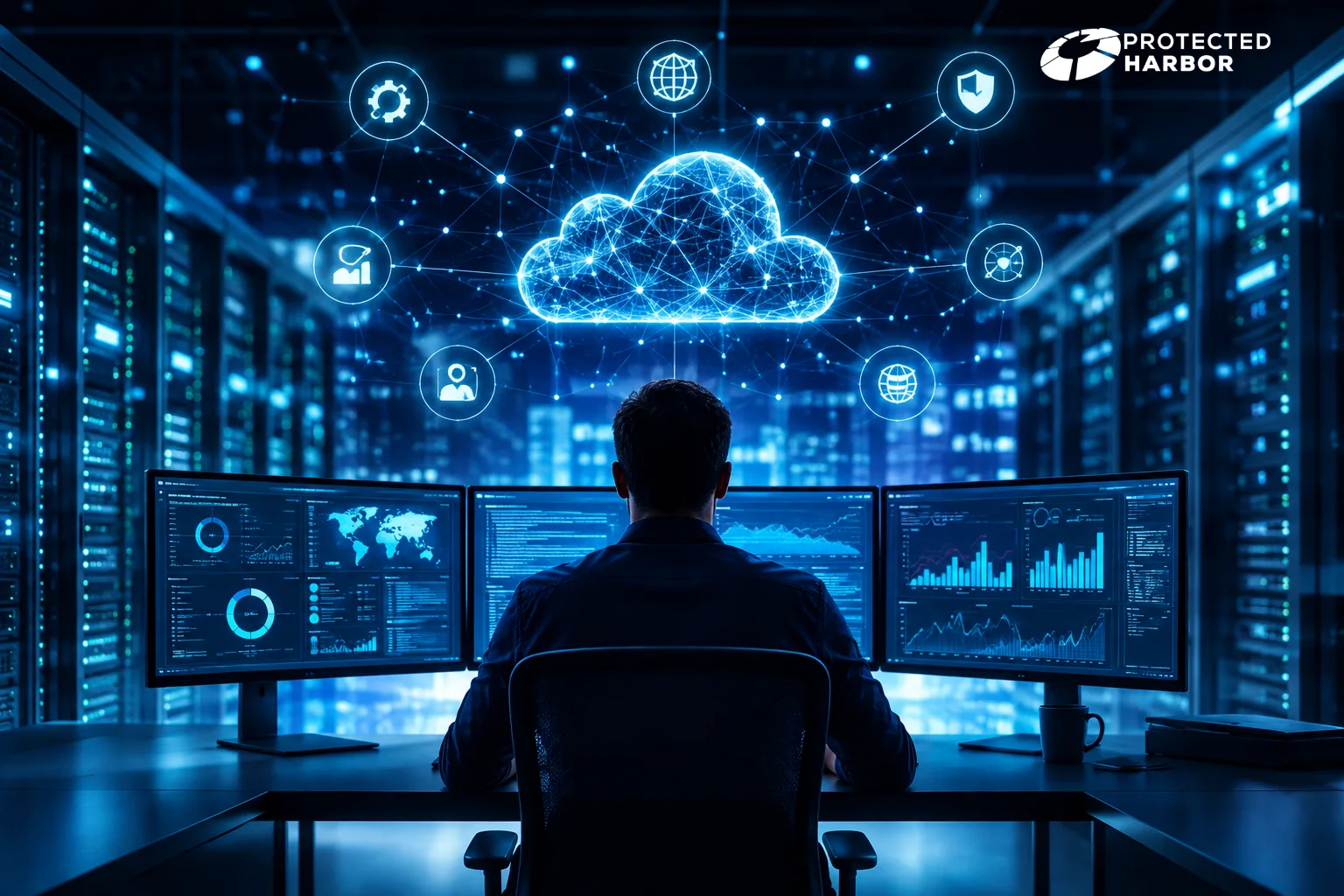
AIOps, or Artificial Intelligence for IT Operations, applies AI and machine learning capabilities to operational workflows.
Instead of requiring IT teams to manually analyze every alert, log, metric, or event, AIOps can aggregate information from across the environment and help identify meaningful relationships.
AIOps capabilities include collecting and aggregating structured and unstructured operational data, automatically establishing baselines, detecting anomalies, grouping events, prioritizing significant alerts, correlating historical and real-time data, identifying probable root causes, and automating operational processes.
AI’s impact on ITOps is profound because it directly addresses the biggest challenges IT teams face: complexity, volume, and speed. Traditional monitoring tools generate thousands of alerts daily — many of which are false positives. AI filters through this noise, prioritizing critical incidents and even predicting potential failures before they disrupt services.
AI doesn’t just enhance IT operations — it redefines them. It enables IT teams to move from reactive problem-solving to proactive optimization, leading to improved reliability, reduced downtime, and greater business agility.
From Monitoring to Observability
Another important evolution in IT operations is the move from traditional monitoring toward observability.
Monitoring can tell you that something is wrong.
Observability helps you understand why.
Modern observability uses metrics, logs, traces, and events to provide insight into the behavior of complex applications and infrastructure. That information becomes particularly powerful when combined with AI.
Imagine an application suddenly becomes slow. A traditional monitoring system might generate an alert because response times exceeded a threshold. An observability platform can provide additional context about what is happening across the application and infrastructure.
AI can then help correlate those signals with recent changes, historical behavior, resource utilization, and other operational data to identify a probable cause.
Instead of simply telling an engineer, 'Something is wrong.', the system can help answer, 'What changed, what is affected, and where should we look first?' That difference can have a significant impact on incident response.
5 Ways AI Is Changing IT Operations
1. Reducing Alert Fatigue
IT environments can generate a lot of alerts. The problem is that not every alert represents an independent problem. AI can group related events, suppress noise, and prioritize the signals that deserve attention. The goal isn’t necessarily fewer alerts. The goal is more meaningful alerts.
2. Detecting Anomalies
Traditional monitoring often relies on predetermined thresholds, but a fixed threshold doesn’t always represent abnormal behavior.
AI and machine learning can establish dynamic baselines based on how systems normally behave and identify deviations from those patterns. This can help teams detect unusual behavior earlier, even when a traditional threshold hasn’t been crossed.
3. Turning Operational Data into Operational Intelligence
AIOps can correlate operational data from across the environment to provide a broader view of an incident to help identify probable root causes. This is one of the most valuable applications of AI in ITOps: not just seeing more, but understanding the relationships between what you’re seeing.
4. Predicting & Preventing Problems
AI can help operations teams move from reactive to proactive management. Historical and real-time operational data can reveal patterns associated with performance degradation, capacity constraints, or recurring incidents.
This gives IT teams more time to respond and address problems before they become outages, minimizing downtime and improving system reliability.
5. Enhancing Efficiency
For repetitive, well-understood operational tasks, such as monitoring, patch management, and incident response, organizations can automate processes or remediation workflows that respond to specific conditions.
Let’s see an example:
Before coming to us, one of our clients had an application that required someone to remain logged into the server to keep it running — a process that often failed overnight. Our team developed a monitoring 'watchdog' that continuously checks application health. If an issue is detected, the system automatically restarts the service and sends alerts notifying engineers when a problem was identified and when it was resolved.
Benefits of AI ITOps
AI is changing what IT operations can do.
This technology can help teams see more, filter noise, detect anomalies, understand relationships, identify probable root causes, predict emerging problems, automate repetitive work, respond faster, and make better-informed decisions.
If your goal is better operations, AI can benefit your organization in many ways, such as:
- Digital transformation and modernization
- Improved accuracy
- Cost savings
- Better visibility
- Enhanced security
- Accelerated decision-making
- Faster incident response
- Fewer disruptions
- More predictable performance
And overall, helping to create a technology environment that better supports your business.
Can AI Replace Engineers?
While AI and automation can do many things, they cannot replace skilled professionals.
Automation can simplify complex IT processes, minimize human error, accelerate task completion, quickly identify/ address issues and notify the appropriate teams, and optimize resource allocation. But while automation is extremely useful, this is where governance becomes critical. AI and automation are most useful when tools and teams work together.
An engineer may know that a particular application is critical during a specific period. They may understand that a certain configuration change is intentional. They may know that a seemingly minor issue could have major downstream consequences.
AI can identify patterns. People provide judgment.
AI can correlate information. People provide context.
AI can recommend an action. People provide accountability.
The Foundation Beneath Intelligent Operations
There is another important consideration that can easily get lost in conversations about AIOps: AI-powered operations are only as effective as the environment they can see and understand.
If operational data is fragmented, incomplete, or inaccessible, AI has less information to work with. If applications and infrastructure aren't properly instrumented, teams may not have the telemetry necessary to understand what's happening. If infrastructure and applications are treated as completely separate environments, it becomes harder to understand how a change in one affects the other. If the underlying infrastructure is unstable, AI may spend its time reacting to symptoms instead of helping optimize the environment.
This is why intelligent IT operations require more than an AI platform.
They require:
- Reliable infrastructure
- High-quality telemetry
- Application visibility
- Strong observability
- Integrated operational data
- Secure access
- Clear automation policies
- Well-defined governance
- Human oversight
The more connected the applications and infrastructure are operationally, the more useful AI can become.
The Future of ITOps is Application-Aware
As organizations adopt increasingly distributed architectures, the traditional separation between application teams and infrastructure teams becomes more difficult to maintain.
Applications depend on infrastructure, infrastructure exists to support applications, and operational problems rarely respect organizational boundaries.
A database problem can become an application problem.
An infrastructure problem can become a customer experience problem.
A network problem can become an availability problem.
This is why the future of IT operations is moving toward a more unified understanding of applications, infrastructure, and the relationships between them. IBM itself recently highlighted the growing importance of unifying application and infrastructure operations as environments become more distributed, hybrid, and interconnected.
AI strengthens that approach by giving operations teams better tools to analyze those relationships at scale.
The Protected Harbor Difference
AI can provide the intelligence, but infrastructure provides the foundation.
At Protected Harbor, we believe those two things should never be considered separately. Applications, data, and infrastructure are interconnected — and operating them effectively requires understanding the entire environment rather than treating each layer as an isolated system.
The future of ITOps isn't simply more automation. It's a deeper understanding of how the entire technology environment works together. That is where intelligent, Application-Aware Infrastructure becomes essential.