Protecting Patient Data 101
10 Healthcare Cybersecurity Best Practices
Patient data is among the most sensitive information an organization can hold. From electronic health records and medical imaging to patient billing systems and connected medical devices, healthcare organizations depend on complex technology environments to store, access, and transmit information. That dependence creates a significant responsibility: protecting patient data while ensuring clinicians can access the information they need to deliver care.
Cybersecurity in healthcare is about more than preventing data breaches. A compromised system can expose confidential patient information, disrupt clinical workflows, delay access to medical records, and interfere with essential healthcare services. With regulations such as the Health Insurance Portability and Accountability Act (HIPAA) establishing requirements for protected health information (PHI), healthcare organizations must have a security strategy that addresses both data confidentiality and the reliability of the systems that support patient care.
So how can healthcare organizations strengthen their defenses? The answer starts with understanding where patient data lives, how it moves through the environment, and what safeguards are needed to protect it at every stage.
Healthcare Is Increasingly at Risk
Cybercriminals target healthcare facilities because the data is extremely valuable. Attackers aim to steal and sell data for fraudulent activity or seek to encrypt existing data to prevent organizations from accessing it unless a ransom is paid. Healthcare facilities are also seen as easy targets since their focus is usually on patient care and not cybersecurity. According to the HIPAA Journal, the number of data breaches reported by HIPAA-regulated organizations has been increasing significantly, with healthcare breaches in 2023/2024 being reported at double the rate they were reported in 2018. The FBI’s Annual Internet Crime Report found that the healthcare/ public health industry was the most targeted sector for ransomware in 2025. Healthcare also ranked number 3 for the most data breaches that year. Additionally, IBM’s 2026 Cost of a Data Breach Report shows an average healthcare data breach cost of $6.64 million in 2026.
Why Patient Data Is a Critical Cybersecurity Priority
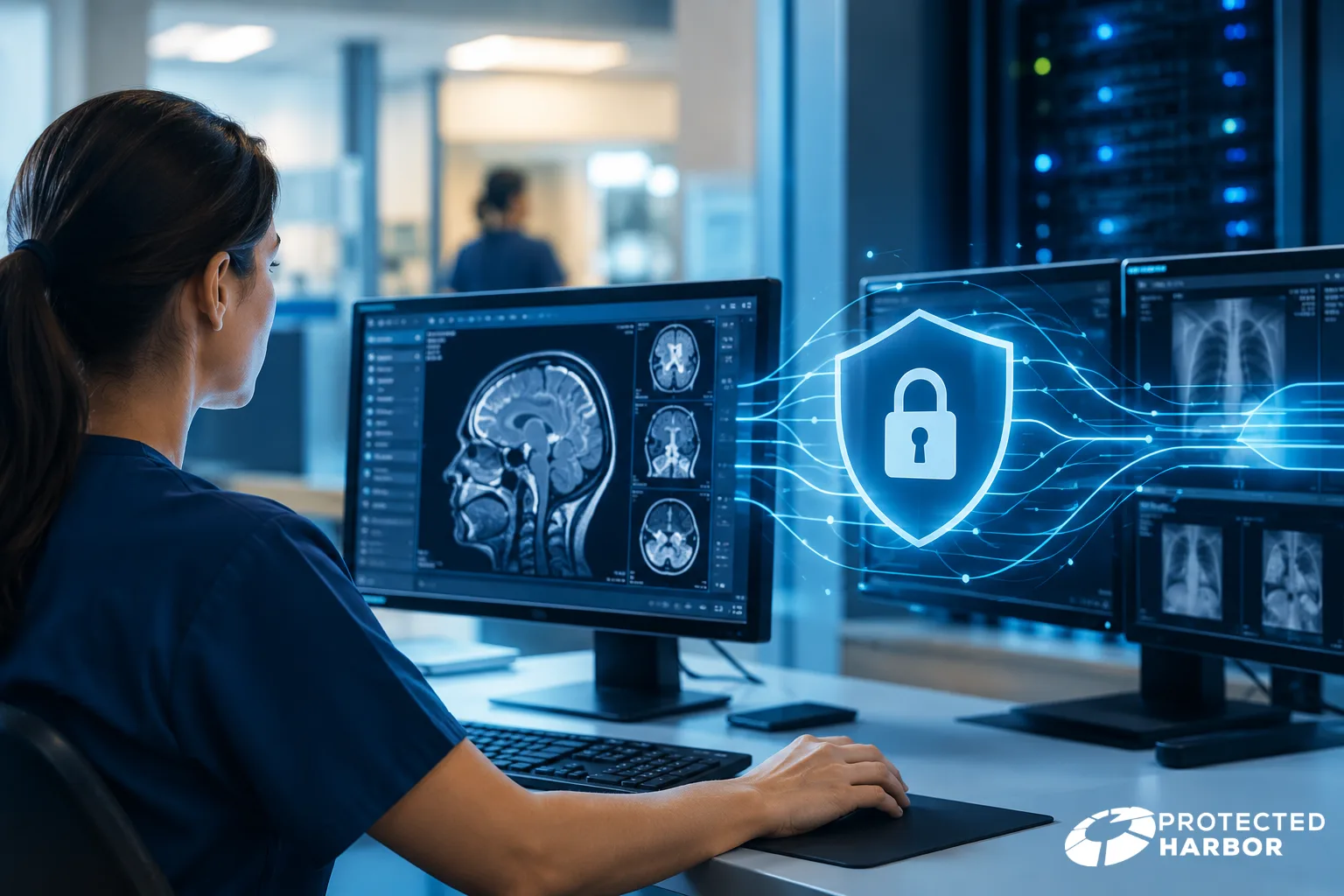
Healthcare environments bring together a wide range of interconnected systems, including electronic health records (EHRs), picture archiving and communication systems (PACS), radiology information systems (RIS), billing platforms, medical devices, cloud environments, and third-party applications. Each system may serve a different purpose, but they often rely on shared infrastructure, networks, databases, and user access. This interconnectedness creates vulnerabilities. A compromised account, an unsecured device, or an overlooked weakness in one system can put other parts of the environment at risk.
Healthcare organizations must also balance security with accessibility. Clinicians need timely access to accurate patient information, and security measures cannot be designed without considering the operational requirements of care delivery. A study from the National Institutes of Health (NIH) highlighted how healthcare data is remarkably vulnerable to hacking, as well as how wide variations in digital health usage complicates cybersecurity, as it can be difficult to create solutions that work for every context or clinician.
Effective healthcare cybersecurity must therefore protect three things:
- Confidentiality: Patient information is accessible only to authorized individuals and used appropriately.
- Integrity: Medical records and other sensitive information remain accurate and protected from unauthorized alteration.
- Availability: Authorized healthcare professionals can access the systems and information they need when they need them.
10 Best Practices for Protecting Patient Data
1. Train Staff to Recognize Cybersecurity Threats
Technology alone cannot eliminate human error. Phishing emails, stolen credentials, accidental data sharing, and unsafe handling of sensitive information can all expose patient data. Regular security awareness training helps healthcare employees recognize suspicious activity and understand their responsibilities when handling PHI. Training should cover phishing, password security, appropriate data sharing, secure system usage, and procedures for reporting potential incidents. Security awareness should be an ongoing process rather than a once-a-year exercise. As threats and workflows change, employees need to understand how to recognize and respond to new risks.
2. Restrict Access to Patient Data
Not every employee needs access to every patient record or application. Limiting access according to job responsibilities reduces unnecessary exposure and helps prevent compromised accounts from becoming a larger security incident. Healthcare organizations should implement role-based controls, strong authentication, and multi-factor authentication (MFA) wherever appropriate. Access permissions should also be reviewed regularly, particularly when employees change roles or leave the organization. The goal is to give authorized users the access they need to do their jobs without granting unnecessary privileges.
3. Monitor How Sensitive Data Is Used
Controlling who can access patient data is essential, but organizations must also understand what happens after access is granted. Data usage controls can help identify suspicious behavior, such as unusual downloads, unauthorized transfers, or attempts to copy sensitive information to external devices. Data discovery and classification tools can help organizations locate sensitive information and apply appropriate protections based on its importance and risk. These controls provide greater visibility into how patient data moves throughout the environment, helping security teams identify potentially dangerous activity before it escalates.
4. Continuously Monitor Systems & User Activity
A security incident may not begin with an obvious system failure. Unusual login activity, unexpected changes to records, or abnormal network traffic can indicate that something is wrong. Comprehensive logging and monitoring help healthcare organizations understand who accessed a system, when access occurred, and whether activity deviated from expected behavior. Monitoring should extend across relevant infrastructure, applications, databases, and network components rather than focusing on isolated systems. When an incident occurs, these records can help teams investigate the cause, determine which systems may be affected, and respond more effectively.
5. Encrypt Patient Data at Rest & in Transit
Patient information needs protection whether it is stored in a database, saved on a device, or transmitted between healthcare systems. Encryption helps prevent sensitive information from being readily understood if protected data is intercepted or accessed without authorization. Healthcare organizations should evaluate encryption for stored data, data transfers, backups, laptops, mobile devices, and other relevant systems. Encryption is an important safeguard, but it works best alongside stronger access controls, secure key management, monitoring, and appropriate system configuration. Organizations should determine that the safeguards appropriate to their environment and applicable HIPAA requirements rather than assuming that encryption alone provides complete protection.
6. Secure Mobile Devices & Remote Access
Healthcare professionals increasingly rely on laptops, smartphones, tablets, and remote connections to access the information needed for their work. These access points can introduce additional risk if devices are lost, stolen, improperly configured, or accessed by unauthorized individuals. Healthcare organizations should establish clear mobile device security policies that include strong authentication, device encryption, centralized management, security updates, and the ability to remotely lock or wipe supported devices when necessary. Remote access should also be controlled and monitored to ensure that convenience does not come at the expense of patient privacy.
7. Protect Connected Medical Devices & Segment Networks
Healthcare environments contain more than traditional computers and servers. Medical imaging equipment, monitoring devices, diagnostic systems, and other connected technologies may communicate across the network. Some devices have specialized operational requirements or limited options for security updates, making them challenging to manage through conventional IT security practices alone.
Organizations should maintain an inventory of connected devices, understand their communication requirements, apply available security updates, and disable unnecessary services where appropriate. Network segmentation is particularly important. Separating medical devices, clinical applications, administrative systems, and other network resources can help limit how far an attacker can move if one device or system is compromised. Security teams should understand the dependencies between these environments so that segmentation improves protection without disrupting essential clinical workflows.
8. Conduct Regular Security Risk Assessments
Healthcare technology environments change constantly. New applications are introduced, systems are updated, vendors change, and additional devices connect to existing networks. A security assessment that was accurate a year ago may no longer reflect the organization’s current risks. Regular risk assessments help identify vulnerabilities, evaluate existing safeguards, and prioritize improvements based on the potential impact of a security incident.
Assessments should consider more than individual applications. They should examine the underlying infrastructure, network architecture, access controls, data flows, recovery capabilities, and third-party relationships that affect patient information. The HIPAA Security Rule requires regulated organizations to conduct an accurate and thorough assessment of risks and vulnerabilities to electronic PHI. The appropriate safeguards depend on the organization’s environment and identified risks.
9. Maintain Secure Backups & Test Disaster Recovery
Ransomware and other cyber incidents can make patient information unavailable even when data has not been permanently destroyed. For healthcare organizations, that creates an operational challenge: how can essential systems and records be restored while protecting the integrity of patient information? Secure backups are a critical part of the answer.
Organizations should establish appropriate backup schedules, encrypt backups, restrict access to backup systems, and maintain protected copies that cannot easily be altered or deleted by an attacker. However, having backups is not the same as having a reliable recovery strategy. Healthcare organizations should regularly test restoration procedures, establish recovery priorities, and understand how long critical applications can remain unavailable without unacceptable operational consequences. Recovery planning should account for the complete environment, including the infrastructure, databases, applications, and integrations required to make restored systems usable.
10. Evaluate the Security of Vendors & Business Associates
Healthcare organizations frequently depend on external providers for hosting, software, cloud infrastructure, data processing, and technical support. These relationships can introduce risks when third parties have access to patient information or systems that support clinical operations. Organizations should evaluate vendors’ security practices, understand their access to PHI, document responsibilities, and establish appropriate contractual protections.
Under HIPAA, covered entities must obtain satisfactory assurances from business associates that PHI will be appropriately safeguarded, and business associates have their own applicable obligations. Vendor evaluations should extend beyond a compliance checklist. Healthcare organizations also need to understand who monitors the environment, who responds to incidents, how recovery is handled, and who is accountable when a problem affects multiple systems.
Healthcare Cybersecurity Requires More Than Individual Security Tools
Each of these best practices plays an important role, but implementing them independently does not necessarily create a secure environment.
Consider a healthcare organization that encrypts patient records, uses MFA, and monitors its network. Those are valuable safeguards, but what happens if its imaging application depends on a database that has not been adequately protected? What if a compromised device can communicate freely with critical servers? What if backups exist, but the team has never tested whether the complete application can be restored?
These questions highlight an important distinction: securing individual components is not the same as securing the environment as a whole. Healthcare applications depend on layers of interconnected technology. Applications, databases, operating systems, networks, storage, and underlying infrastructure must work together to support patient care. A weakness in one layer can affect the security, performance, or availability of the entire application.
That is why healthcare cybersecurity needs an infrastructure-level perspective. Organizations should understand how their applications operate, what systems and services they depend on, how sensitive information moves between components, and what must happen to restore services after an incident. When security, monitoring, infrastructure management, and recovery planning are coordinated, healthcare organizations are better positions to identify vulnerabilities, respond to threats, and maintain access to essential systems.
Protecting Patient Data Starts with Understanding Your Infrastructure
At Protected Harbor, we believe healthcare infrastructure should be designed around the applications it supports. Our Application-Aware Infrastructure approach connects infrastructure engineering, cloud environments, DevOps, monitoring, and operational accountability to help organizations manage the technology their applications depend on. For healthcare organizations, this means looking beyond individual servers or security tools to understand how the complete environment supports patient care, data protection, and application availability.
A more comprehensive infrastructure strategy can help organizations identify potential weaknesses, improve visibility, plan for recovery, and better understand how changes to one component may impact the rest of the environment. Protecting patient data is not just about preventing unauthorized access. It is also about ensuring the systems healthcare professionals depend on remain reliable, recoverable, and available when needed.
Take the Next Step Toward Stronger Healthcare Cybersecurity
Protecting patient data requires ongoing attention to security controls, infrastructure dependencies, vendor relationships, and recovery readiness. Healthcare organizations should regularly evaluate their environments to identify gaps, prioritize risks, and ensure their security strategy reflects how their systems actually operate.
Is your infrastructure prepared to protect patient data and support critical healthcare applications?
Contact Protected Harbor to learn more about our healthcare infrastructure solutions and request a complimentary infrastructure resilience assessment for your environment. No obligation — just clarity on where you stand.
This article is for general educational purposes and is not legal advice or a guarantee of regulatory compliance. Healthcare organizations should consult qualified compliance and legal professionals regarding their specific obligations.