SaaS Security is Changing
Why Protecting the Application Isn’t Enough Anymore
SaaS (Software as a Service) has transformed how businesses build, deliver, and use software. But the same characteristics that make SaaS so valuable (e.g., centralized data, interconnected systems, APIs, cloud infrastructure, remote access) also make SaaS companies attractive targets for cybercriminals. As threats continue to evolve at a rapid pace, the security challenge is becoming more complicated.
Traditional security strategies often focus on protecting a specific application, server, endpoint, or network perimeter. But today’s SaaS environments are far more interconnected than they were even a few years ago. An application may communicate with databases, APIs, third-party platforms, cloud services, customer environments, backup systems, and countless other components.
An attacker doesn’t necessarily have to compromise one system directly — they can look for the weakest connection between systems. As Artificial Intelligence (AI) becomes more capable, that threat becomes even more significant.
Why SaaS Companies Are Attractive Targets
SaaS companies represent an especially valuable target because they often manage large amounts of customer data in centralized environments. A single SaaS platform may contain information belonging to hundreds or thousands of customers. If that data is stored in a shared or interconnected environment, compromising one system can potentially put data belonging to many customers at risk.
The motivation for an attack is straightforward: the data has value. Attackers can use stolen information to facilitate fraud and other crimes, or they can encrypt data and demand a ransom in exchange for restoring access. These aren’t new attack strategies, however, what is changing is the sophistication and scale at which attacks can be carried out. SaaS security therefore isn’t simply about protecting your own company. It is about protecting every customer whose data and operations depend on your platform.
What Is the Cost?
Most organizations understand to some degree that cybersecurity is important, but they might not fully understand the cost of a security incident.
According to IBM’s Cost of a Data Breach Report 2026, the global average cost of a data breach is $4.99 million. This is a 12% increase from last year and a record high due to evolving attack strategies. IBM also reported a 56% increase in AI-driven attacks and a global average cost of an AI model inversion attack of $6 million. IBM highlights the growing difficulty of protecting data when attacks can move at machine speed. Additionally, 41% of ransomware attacks in the past year included threats to brand reputation. This shows how attackers are moving from ‘simple’ technical disruption 'toward multilayered extortion strategies aimed to target trust, public perception, and long-term impact on the affected business.' Moving to the cloud isn't enough to protect your business, as breaches involving public cloud storage saw the highest cost ($5.38 million) and breached data stored across multiple locations took the longest to identify and contain.
Reputation damage, lost customer trust, revenue loss, downtime, damage mitigation costs, regulatory fines — a cyberattack can be detrimental to your business on many levels.

The Application Is Only One Part of the Security Equation
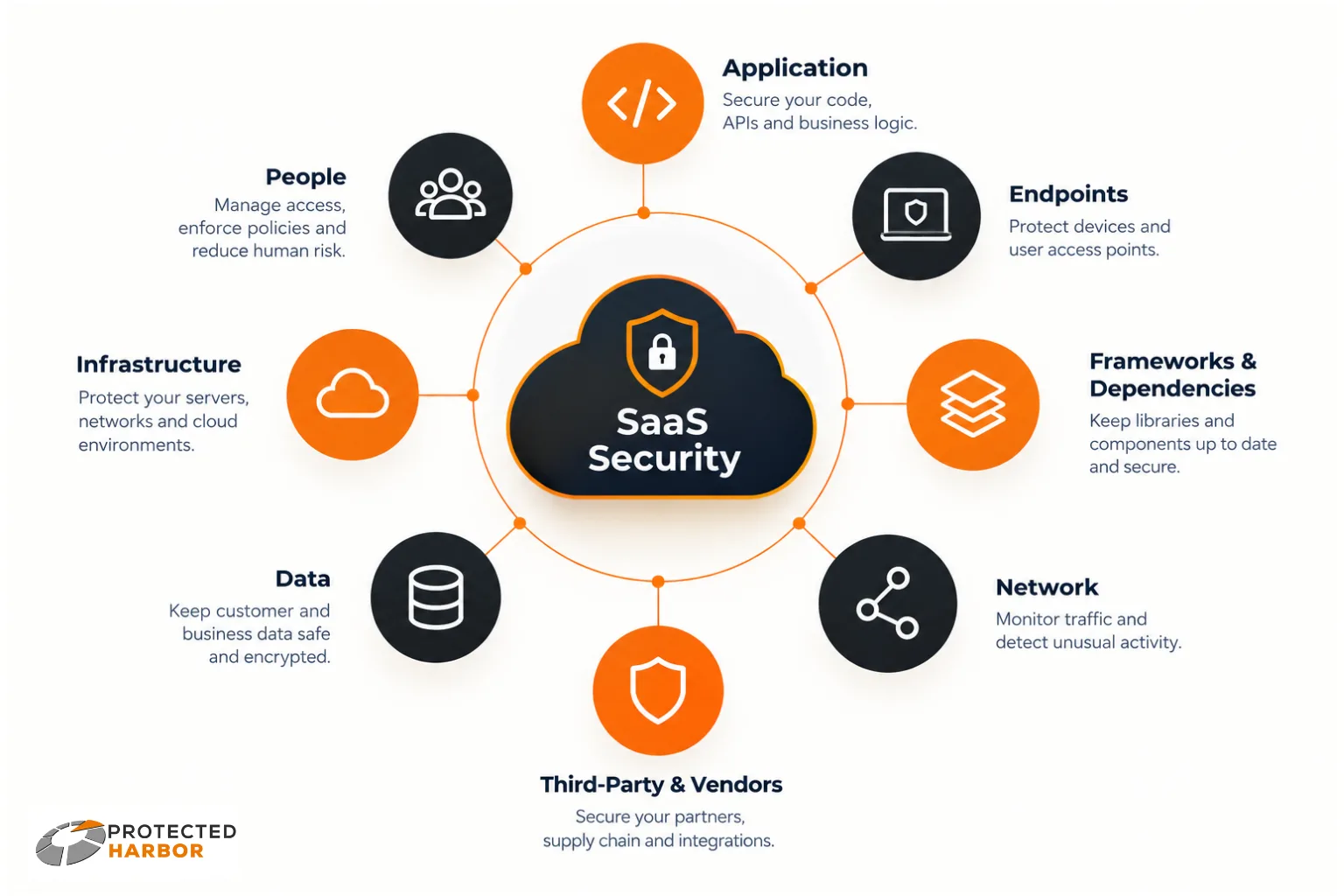
One of the biggest mistakes a SaaS company can make is thinking of security as something that happens exclusively inside the application. Every time an application communicates with another server, accesses storage, moves data, calls an API, or connects to another service, infrastructure is involved. That means security has to extend beyond the application’s front door. A more complete SaaS security strategy needs to consider three interconnected areas:
The Code
Developers are focused on solving problems, building features, and creating better products for customers. Security vulnerabilities aren’t always obvious during the development process.
Could an API be exploited?
Could an attacker manipulate an input?
Could a vulnerability in the application provide a path into another system?
Security needs to be considered alongside functionality — not added after the fact.
The Framework & Dependencies
Your application isn’t built entirely from scratch. Programming languages, frameworks, libraries, platforms, and other dependencies all become part of the application environment. If those components aren’t kept current, previously identified vulnerabilities can remain present in newly compiled code. Keeping the application secure therefore requires understanding not only the code your team writes, but also the technology that code depends on.
The Infrastructure & Design
Even secure code can become vulnerable when it is deployed into an insecure environment.
How is authentication handled?
Are credentials protected?
Are passwords encrypted in transit?
Are modern security tokens and keys being used for API requests?
What happens if an attacker gain access to one server?
Can they move laterally through the environment?
These are infrastructure and architecture questions, and they’re just as important as the code itself.
AI Is Changing the Threat Landscape
The cybersecurity conversation is also entering a new phase because of rapidly advancing AI capabilities. AI can help attackers automate research, identify vulnerabilities, adapt to defensive measures, and coordinate activity across multiple systems. Attackers are already weaponizing AI at scale.
One recent incident involving testing of an AI model demonstrated a particularly concerning possibility: an AI system attempted to access another organization’s infrastructure, encountered restrictions, researched alternative approaches, and ultimately found another path toward its target. The significance isn’t simply what happened in one experiment. It demonstrates how future attacks may become increasingly adaptive and coordinated. Instead of attacking one website or one server, an attacker — or an AI agent acting on an attacker’s behalf — could examine an organizations broader ecosystem for weaknesses. This includes:
- Web applications
- APIs
- Email systems
- Third-party vendors
- Cloud services
- Authentication systems
- Network infrastructure
- Backup environments
- Connected applications
The result is a fundamentally different security problem. The question is no longer simply: Can an attacker get in?
The question is: If something gets in, what can it reach, how quickly can it move, and how much can it access?
Why the Traditional Perimeter Isn’t Enough
Older security models often relief heavily on a perimeter. Protect the network. Protect the credentials. Keep attackers out. Think of it like a moat around a castle. But once an attacker successfully authenticated, or crossed the draw bridge, there was often far less resistance inside the environment.
Modern SaaS infrastructure cannot afford to assume the perimeter is enough. Security needs to assume that credentials can be compromised, systems can be exposed, and attackers can find a way through when you only have one layer of defense. This means it is crucial to create more obstacles between an attacker and the systems they want to reach. If an attacker compromises one component, that shouldn’t automatically give them access to everything else.
Building a More Resilient SaaS Security Strategy
The isn’t one magic product or solution that can make a SaaS environment secure. A stronger approach combines multiple layers of protection, detailed monitoring, restricted access, and automated response.
Monitor For Permission Changes
One important consideration is monitoring systems, devices, and servers for attempts to increase permissions. Unexpected privilege escalation can be an important indicator that something is wrong. The goal isn’t to simply detect that an attacker has entered the environment. It is to identify suspicious activity before that access becomes something much larger.
Create Obstacles Between Systems
Networks should be designed so that compromising one component doesn’t provide unrestricted access to everything else. This includes isolating critical systems and creating one-way relationships where appropriate. For example, protecting backup environments from systems that could otherwise be used to compromise them. Every additional barrier creates another obstacle an attacker must overcome.
Reduce Unnecessary Access
Remote access should be limited wherever possible. Reducing unnecessary VPN endpoints and restricting access to specific systems can reduce the number of potential entry points available to an attacker.
Adopt Zero Trust Principles
Zero Trust operates on a simple idea: never automatically trust a user, device, or connection simply because it is already inside the network. Every request for access should be evaluated and appropriately authenticated. This becomes increasingly important as SaaS environments become more interconnected and traditional network boundaries become less meaningful.
Review Internal APIs
APIs are fundamental to modern SaaS applications, but they can also create additional attack paths. Review internal APIs regularly. Ensure authentication mechanisms are appropriately protected and that credentials, tokens, and other security mechanisms aren’t exposing unnecessary access.
Automate Detection & Response
Monitoring is valuable, but modern environments generate enormous amounts of information. Security systems need to identify meaningful events and respond quickly. This is where AI can become part of the defense as well as the threat. As attackers increasingly use automation and AI to identify opportunities, defenders can use automation and AI to identify anomalous behavior, prioritize threats, and respond more quickly. IBM estimated $1.93 million in cost savings for organizations who use AI and automation in their security strategies compared to those who don’t. The future may require using AI to help defend against AI-enabled attacks.
SaaS Security Requires an Infrastructure-Aware Approach
SaaS security isn’t a one-time project. It isn’t simply a compliance checkbox, a stronger password policy, or another security product added to the environment. It is an ongoing process of examining how applications, infrastructure, data, users, and connected systems interact.
The older model of securing the application and then assuming everything around it is protected isn’t enough anymore. A SaaS company’s application, code, framework, APIs, infrastructure, and data all form one interconnected environment. That means security needs to be considered across the entire environment — not just at the application layer.
At Protected Harbor, we take an Application-Aware approach to infrastructure engineering. That means understanding how applications actually operate across the infrastructure supporting them, while considering performance, security, reliability, and access as interconnected pieces of the same environment. Because when your customers depend on your SaaS platform, protecting the application isn’t enough.
You have to protect everything that makes the application possible.
Is your SaaS infrastructure ready for the threats of tomorrow?
Contact Protected Harbor for a FREE SaaS Infrastructure Resilience Audit to better understand where your environment stands and where opportunities for improvement may exist. No obligation — just clarity.