
Integrating AI With Your Technology: Building a Stronger Foundation for Healthcare
Artificial Intelligence (AI) is rapidly changing what healthcare organizations can accomplish. The healthcare industry is facing rising operational costs, a global shortage of providers, and an overwhelming administrative burden. AI helps to address these systemic challenges.
From analyzing medical images and identifying patterns in patient data to automating workflows and supporting clinical and operational decisions, AI is becoming an increasingly important part of the healthcare technology landscape. Johns Hopkins reported that “85% of healthcare leaders are adopting generative AI at scale to streamline clinical productivity and patient engagement.”
However, an AI application is only as effective as the technology environment supporting it. If data is fragmented, infrastructure is undersized, applications are poorly integrated, or security controls are inconsistent, introducing AI can create as many challenges as it solves.
The organizations that get the most value from AI will not simply be the ones that adopt the most advanced tools. They will be the ones that build the right foundation to support them. This blog delves into practical implementation strategies and how AI can assist healthcare organizations in achieving their goals.
The Growing Role of AI in Healthcare
AI is already being used across the healthcare industry to process large volumes of information and identify patterns that may be difficult or time-consuming for people to recognize manually.
In medical imaging, for example, AI can assist with identifying patterns and anomalies that support earlier detection and more informed clinical decisions. In other areas, AI can help automate repetitive administrative tasks, analyze operational data, support patient communication, and provide insights that help organizations make better decisions. The potential is significant.
Healthcare organizations have access to enormous amounts of data, but the value of that data depends on how effectively it can be collected, connected, protected, and used. That makes infrastructure a critical part of any AI strategy.
AI Adoption Starts with the Right Technology Foundation
Before introducing AI into an existing environment, healthcare organizations should take a closer look at the infrastructure supporting their applications and data. This means asking questions such as:
- Where does the data AI will rely on actually reside?
- Is the data accurate, accessible, and properly structured?
- Can existing infrastructure support additional AI workloads?
- How will AI integrate with existing applications and workflows?
- How will sensitive information be protected?
- Can the environment be monitored effectively as AI becomes part of the technology stack?
- What happens if an AI-dependent application or service becomes unavailable?
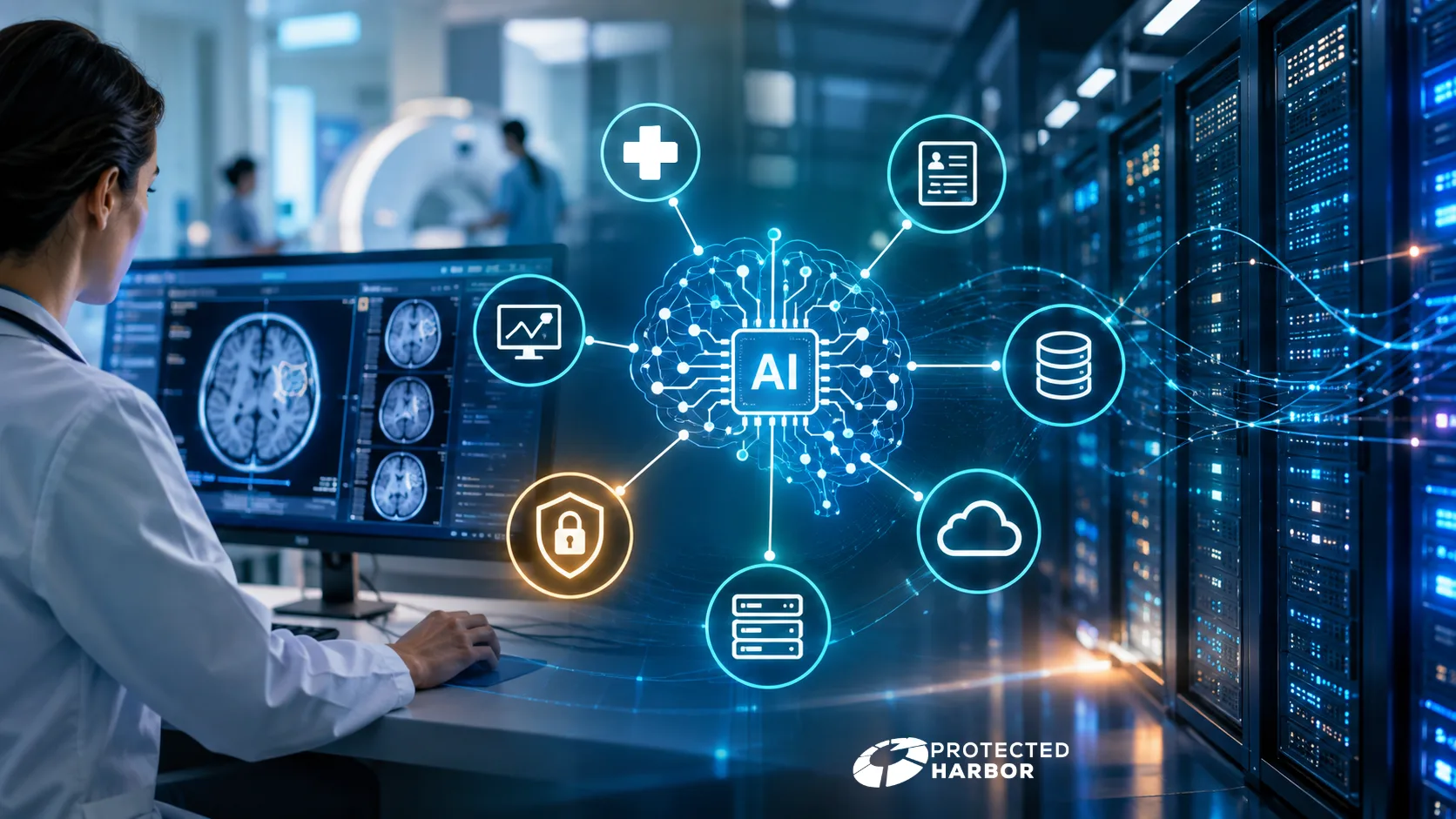
These questions are important because AI does not operate independently. It becomes another component of an organization's broader technology ecosystem. For healthcare organizations, that ecosystem can include electronic health records, PACS and RIS environments, databases, clinical applications, patient-facing systems, cloud resources, on-premises infrastructure, and numerous integrations between them. AI needs to fit into that environment — not operate around it.
6 Considerations for Successful AI Integration
1. Define the Business & Operational Goal
AI implementation should begin with a clearly defined problem. What are you trying to improve? Perhaps the goal is to reduce repetitive administrative work. Maybe it is to improve the efficiency of a radiology workflow, analyze large datasets, improve patient engagement, or provide staff with faster access to information. A clearly defined objective provides a framework for determining whether AI is actually successful. Without that framework, organizations can end up adopting AI just to have it rather than because it addresses a meaningful business or operational need.
2. Understand, Prepare, & Protect Your Data
AI systems rely on quality data for accurate insights. It is extremely important for organizations to have robust data collection processes, and clean and pre-process the data to eliminate errors and inconsistencies. For healthcare organizations, this consideration becomes even more important. Before implementing AI, healthcare organizations should understand:
- What data the AI system can (and can’t) access
- Where that data is stored
- How data moves between applications and systems
- Who or what has access to the data
- How access is authenticated and authorized
- How data is protected while stored and transmitted
- How data is retained, monitored, and ultimately removed
The goal is to create an environment where the right data can be accessed reliably and securely when it is needed, while also ensuring that introducing AI does not unintentionally create a new pathway to sensitive data.
3. Evaluate the Infrastructure Supporting AI
AI workloads can introduce new infrastructure requirements. Depending on the application, organizations may need additional processing capacity, storage, networking, security controls, integrations, or specialized infrastructure. However, adding resources alone does not solve the problem. Infrastructure should be evaluated in the context of the applications and workflows it supports.
For example, an AI solution incorporated into a radiology environment may depend on the performance and availability of the broader imaging ecosystem. PACS, RIS, databases, networking, storage, and other application components all contribute to the overall experience. If one part of that environment becomes a bottleneck, the AI application may not deliver the expected value.
This is why AI readiness should be considered an infrastructure and application strategy, not simply a software decision. Engage domain experts, data scientists, and AI specialists to collaborate on implementing AI solutions. Their expertise will be crucial in understanding the intricacies of your business and leveraging AI effectively.
4. Start Small, Then Scale
AI adoption does not have to happen all at once. Beginning with a focused pilot allows organizations to evaluate how an AI solution performs in its actual environment before expanding it across the organization. A successful pilot should evaluate more than whether the AI tool works. A pilot project should also evaluate:
- Application performance
- Infrastructure utilization
- Data accessibility
- Security
- User adoption
- Workflow impact
- Reliability
- Operational costs
5. Monitor, Measure, & Adapt
AI implementation is not a one-time project. Organizations should continuously evaluate the performance and impact of AI systems. It’s important to define and monitor critical metrics (for application performance, infrastructure health, resource utilization, etc.), gather user feedback, and adapt your AI strategy to maximize its benefits.
6. Build AI Into a Secure Healthcare Environment
AI introduces tremendous opportunities for healthcare, but it’s also crucial to discuss the security implications. Healthcare organizations already operate some of the most sensitive technology environments in the world. Patient records, diagnostic images, clinical information, financial information, and other sensitive data move across applications and systems every day. Introducing AI into that environment creates new questions about where data goes, who can access it, how it is processed, and how the AI system itself is secured. Security cannot be treated as an afterthought. AI should therefore be implemented with the same focus on resilience and accountability expected from the rest of the healthcare technology environment.

Key Security Considerations
One of the most important considerations is understanding exactly what information an AI system will access. Healthcare AI applications may interact with patient information, medical images, clinical documentation, operational data, or other sensitive datasets. Organizations need to understand where that information is stored, how it is transmitted, and what happens to it throughout the AI workflow.
AI Creates New Access Points
Every new integration can introduce another potential access point into an organization's technology environment. An AI system may need to communicate with existing applications, databases, APIs, file systems, or other infrastructure. Those connections need to be carefully evaluated and secured.
For example, an AI application supporting medical imaging may need access to information from an existing imaging environment. That means the security of the AI solution cannot be evaluated in isolation. A secure AI implementation strategy therefore requires visibility across the entire technology stack, not just the AI application.
Access Control is Crucial
AI can potentially make information easier to access and analyze, which is part of its value, but greater accessibility also creates greater responsibility.
Healthcare organizations need to establish clear controls around who can interact with AI systems and what information those systems are permitted to access. This is where principles such as least-privilege access, strong authentication, and continuous verification become particularly important. AI should not automatically have access to everything simply because it is connected to the environment. Access should be intentional, limited to what is required, and continuously evaluated.
Protecting the AI Workload Itself
AI infrastructure, models, applications, integrations, and supporting services all become part of the organization's technology environment, which means they need to be monitored and protected like other critical systems. Organizations should consider questions such as:
- What happens if an AI service becomes unavailable?
- How is unusual activity detected?
- Can administrators identify unexpected access or changes?
- What safeguards exist around AI integrations and APIs?
- How are AI-related workloads monitored?
- What happens if an AI system produces an unexpected or compromised output?
- How does the organization respond if an AI component is compromised?
Security Is Also an Operational Issue
One of the biggest mistakes organizations can make is treating AI security as something that belongs exclusively to the security team. AI affects infrastructure, applications, data, workflows, compliance, and users. Security therefore needs to be considered across all of those areas. Your organization may have strong security controls around its existing infrastructure, but introducing a new AI application can change the way information moves through that environment. Organizations should not only ask if the AI application is secure, but also consider what the AI application changes about the security of your environment.
True partnerships are built on shared values and goals. At Protected Harbor, we collaborate with clients who value teamwork and transparency. We’re incentivized to prevent problems, not react to them. Our model only works when our clients succeed — which is why we prioritize collaboration, shared goals, and proactive solutions over quick fixes.
AI Is Only as Strong as the Environment Supporting It
It’s tempting to think of AI as a standalone technology that can simply be added to an existing environment. In reality, AI can expose weaknesses that already exist within an organization's technology stack.
A fragmented data environment can make AI implementation difficult.
Insufficient infrastructure can limit performance.
Poorly integrated applications can create workflow problems.
Weak security practices can introduce additional risk.
Limited visibility can make it difficult to understand what is happening when something goes wrong.
AI does not eliminate these challenges — it can make them more apparent. That is why healthcare organizations should consider AI readiness and infrastructure readiness together.
Building Toward the Future of Healthcare Technology
The organizations best positioned to take advantage of AI will be those that treat adoption as more than a technology purchase. They will understand how applications interact with infrastructure, how data moves through the organization, where potential bottlenecks exist, and how security and reliability can be maintained as technology evolves. Healthcare organizations that build a strong technology foundation today will be better positioned to evaluate and adopt new capabilities tomorrow, without having to completely rethink their infrastructure every time technology changes.
Preparing Your Healthcare Infrastructure for AI
AI presents enormous opportunities for healthcare organizations, but realizing those opportunities requires more than implementing an AI application. It requires a technology environment that can operate securely, reliably, and at scale.
For healthcare organizations, that means looking beyond the AI system itself and evaluating the entire environment supporting it. Is the data accessible and protected? Are applications properly integrated? Can the infrastructure handle the workload? Are access controls appropriate? Can the organization see what is happening across the environment? Are compliance standards being met? And most importantly, who is accountable for all of it?
Protected Harbor helps organizations evaluate the infrastructure, applications, and technology environments that support their critical operations. By understanding the relationship between applications and the infrastructure beneath them, organizations can identify potential gaps, improve resilience, and build a stronger foundation for emerging technologies such as AI.
Is your infrastructure ready for AI? Take advantage of a FREE AI Infrastructure Resilience Audit to better understand where your environment stands and where opportunities for improvement may exist.